
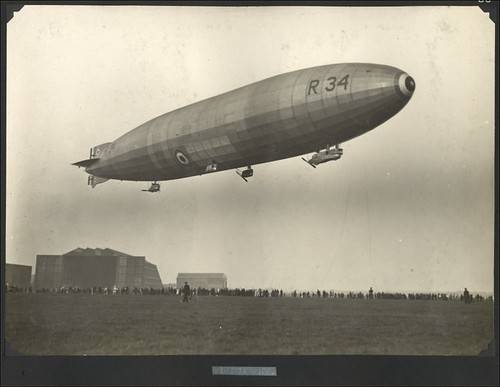
On a cold and misty night in July, 1919, His Majesty’s airship R.34 set out from Scotland on what was to be a record-breaking flight to New York. It was the first time that an attempt had been made to fly across the Atlantic ‘the hard way’ from East to West, against the prevailing winds; radio communications at that time were unreliable, little was known about weather conditions over the 3000 mile route, and the ship’s engines proved unreliable. Chances of survival for the crew of 30 cannot have been much better than even and the living conditions were primitive, the only cooking facilities being ‘a large flanged plate welded to the exhaust pipe of one of the motors’.
Working from painstaking research in the records and the reminiscences of those members of the crew still living, author Patrick Abbott describes in detail the enthralling day-to-day story of the flight in his book ‘Airship‘ which we have in the library and you can read on the Internet Archive here.
Abbott describes the launch thus…
“At midnight the crew sat down to a hearty supper and drank the health of R.34 before leaving to don their heavy flying suits and take their places on the airship, fastened down and ready in her floodlit hangar. A tractor laboriously pulled aside the heavy doors and the ground-crew crowded inside to group themselves in readiness around the grey bulk. There were nearly 700 of them all told; 400 airmen, 80 members of the women’s branch and 150 soldiers of the Black Watch. Together they took hold of ropes, rails and guys, releasing the airship from her moorings and holding her down by their own strength and weight. The last adjustments took place, Major Scott gave the word, ‘Walk her out!” and the bugler took up the command. Guided and led by the swarm of handlers about her, R.34 emerged from the hangar very slowly, like a moth from its chrysalis. Overhead, low clouds and mist obscured the sky and a slight wind from the north-east brought flurries of rain to increase the biting cold. The weather forecast for the Atlantic had been favourable, however, and Major Scott had decided to wait no longer. Gradually and carefully the airship was swung round to point into the wind, and there she paused on the brink of flight. As the engine telegraph rang out, the engines coughed and spluttered reluctantly into life, spinning slowly for two or three minutes to warm up. In the control-cabin Major Scott waited until word was received from Lieutenant Shotter that all was ready.”
The Airship launched from East Fortune airfield just south of Edinburgh on 2 July 1919 and landed in New York on 6 July just before 2pm. 3,139 miles in 108 hours and 12 minutes – a world endurance record. The return journey took 75 hours 3 minutes to cover 3,314 miles.


“It was now eighteen minutes ahead of schedule-1.42 a.m. and as Major Scott signalled ‘Let go!” the sharp notes of the bugle shrilled out above the sound of the engines. Immediately, the ground crew released the handling guys and R.34, freed from all external weight, lifted ponderously into the overcast sky. Again the telegraph sounded and with clutches engaged the propellers spun to the heightened roar of the engines. Gathering momentum and rising slowly, the airship was soon lost to view in the engulfing clouds. Even as she circled to set her course north west for the Clyde, there came faintly to the ears of the crew the sound of a thousand voices, joined together in a farewell burst of cheering. Dropping some of the water ballast, Major Scott increased the engine revolutions to 1,600. The telegraph rang out a signal to the four engine rooms and their acknowledgements showed on the dials to his left. Everyone on board knew that the start of a long airship voyage was potentially the most hazardous part. Each minute brought its small consumption of petrol and its tiny decrease in the overall weight, so the farther an airship travelled, the lighter it became and the higher it could safely ascend. In order to carry the greatest weight of fuel, the captain had loaded R.34 to her maximum capacity, with both payload and hydrogen. At nearly ground level her static lift had been only just sufficient to raise her clear of the immediate obstacles, and now the thrust of the engines was required to provide the dynamic lift that was keeping her aloft. She was already flying about a ton heavy and ahead of her, invisible in the darkness, were the Scottish hills. The next hours would be critical, the ship being in danger of flying either too high or too low. If she were to force her way upward, the decreased air pressure would cause the already taut gasbags to expand, leaking their precious contents through the automatic valves. Until the fuel supply burned lower, this loss of lift would pose a serious threat to safety. At first, there was no need for the delicate choice, as the course plotted by Major Cooke led along the Firth of Forth and no great height was required. By now the first clouds had cleared, and from their gondola windows the airmen stared down 1,500 ft to the lights of Rosyth and a plume of white smoke streaming from the red glow of a passing express train.
Although the actual transatlantic crossing was to be in the teeth of the prevailing winds, at this stage of the journey there was a following breeze of 25 m.p.h. sweeping R.34 forward at a groundspeed of 65 m.p.h.”
When they landed it had been a close thing, though: there were only 140 gallons of fuel left-enough for about two hours’ flying on reduced power. The airship received a tumultuous welcome in New York, the crew were bombarded with invitations and hospitality, and when they entered public rooms, everyone stood up.
It had indeed been an epic journey (illicitly enjoyed by two stowaways, William Ballantyne and a cat named ‘Whoopsie’), and one that made aeronautical history. A wealthy actress offered $1,000 for the cat and when refused, she gave it a gold collar.

The return journey was inevitably peppered with mishaps, the first being the failure of one of the engines. However, they made it back to UK safely – albeit the final leg on only two working engines – and as they approached the 400-strong ground crew they discharged water ballast over the hastily-organised band assembled on the field playing ‘See the Conquering Hero Comes’.
The journey took 3 days 3 hours and 3 minutes. Since leaving East Fortune, R34 had covered more than 7,000 miles at an average speed of 37.1 knots ( about 42 mph).
Air Commodore Maitland published a thorough log of R34’s journey in his book ‘R34’ in 1920 and he includes a list of provisions carried for the crew of 30 (See an image of the list here.)
This drawing from The Illustrated News July 1919 shows details of the airship.

The forward gondola is displayed in the RAF Museum in London.