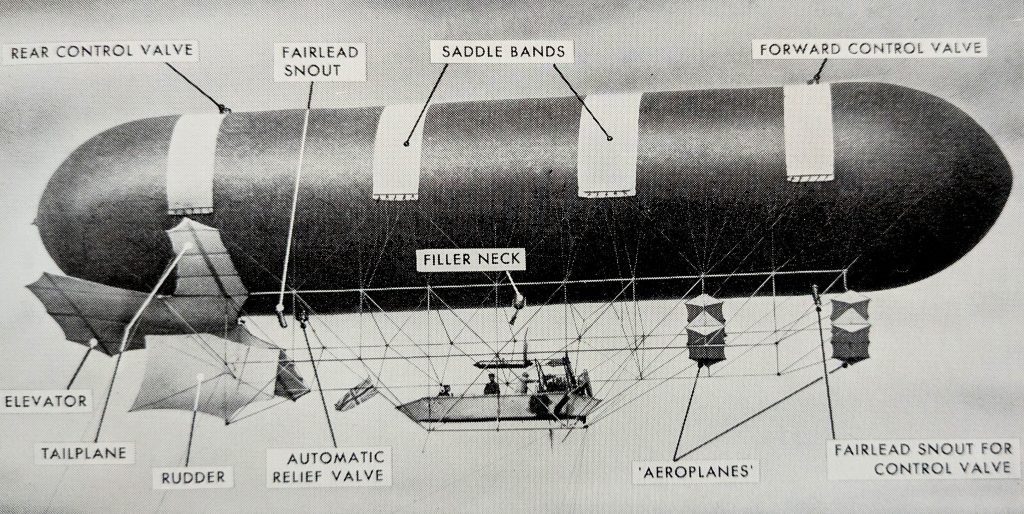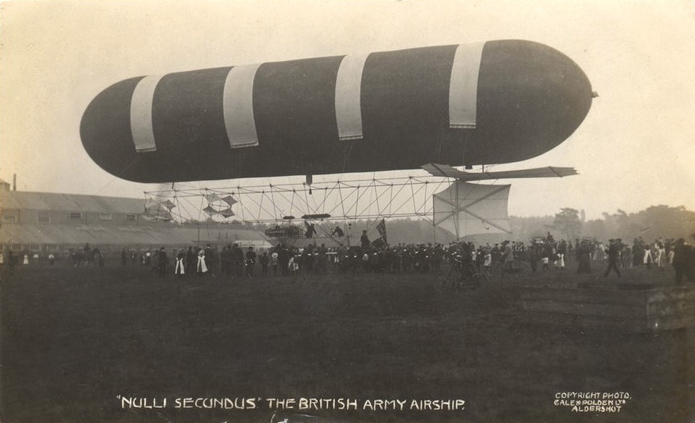
5 October 1907: The British Army Dirigible No 1, Nulli Secundus, flown by Colonel John E. Capper, Royal Engineers, Superintendent of the Royal Balloon Factory, and Samuel Frederick Cody, made a flight from the Balloon Factory at Farnborough to London. After circling St. Paul’s Cathedral, the crew attempted to return to Farnborough but unfavourable winds forced them to moor the airship at the Crystal Palace. The flight covered a distance of 40 miles (64 kilometers) and took 3 hours, 25 minutes.
The British Army was well acquainted with lighter than air flight after contributing greatly to the 19th century South African war with observation balloons with Lieutenant-Colonel J.L.B Templer in charge and it it was Templer who was so instrumental in setting up the Royal Balloon factory in Farnborough.
Samuel Cody was also successfully developing man-carrying kites for use when too windy for balloons and Colonel Capper gained ballooning experience in order to pursue his dream of building an Airship with Templer before he retired.
The French and Germans were progressing in leaps and bounds with Airships and Charles Rolls visited Santos Dumont to learn about his Airships in 1901 with a view to persuade the British Army to invest in this new form of transport but it wasn’t until 4 August 1903 that the war Office wrote to the Superintendent of the Balloon factory authorizing the expenditure of £2,000 for the construction of a dirigible balloon and it was this Airship that made the memorable flight to London in 1907.
A contemporary news article described the event:
The military airship “Nulli Secundus” made a successful trip to London from Farnborough on Saturday last. Starting at 10.40, with Colonel Capper and Mr. Cody on board, the airship—a huge sausage-shaped balloon of goldbeater’s skin of thirty thousand cubic feet capacity driven by a fifty horse-power petrol-engine—travelled to London at a rate of about twenty-five miles an hour, passing over Buckingham Palace and the War Office, and circling round St. Paul’s. On the return journey a strong head-wind brought the airship almost to a standstill over Clapham Common, and its course was altered to Sydenham, where it descended safely in the grounds of the Crystal Palace. From the spectacular point of view, the experiment was a splendid success, as the airship passed over London at a height of only seven hundred and fifty feet, and at this stage of the journey seemed to be completely master of the elements. Journalists who talk of “the conquest of the air,” however, or declare that Colonel Capper’s fifty-mile flight has completely changed the strategic position of Great Britain, will do well to note that gallant officer’s modest estimate of his achievement. The conditions of the experiment were exceptionally favourable. “At the start the pilot-balloon we sent up showed that there was no wind at all.” The slight breeze which sprang up was with them on their way to London; but the moderate head-wind at Clapham prevented them from making any progress at all. Colonel Capper summed up the lessons of the trip by observing:—”We have got a decent slow-speed airship which we can navigate if the wind is not too strong”—i.e., more than fifteen miles an hour—”and which can be raised and depressed at will without the use of ballast. We do not pretend that what we have done to-day is anything first-class, but we do say it is satisfactory as a first attempt.” We may further note that the return journey to Farnborough has been abandoned owing to the damage done to the airship by a high wind on Thursday morning.
Santos Dumont and Charles Rolls 1901